
The Paradigm Problem
Why food system interventions keep getting absorbed


A few weeks ago I wrote about the five conditions that need to be present for plant-rich food behaviors to stick. That piece was about what’s missing. This one is about why so many interventions, even good ones, fail to shift the system at all.
If you believe, as I do, that moving toward more plant-forward eating matters for climate, health, and sustainability, the last decade brought real progress. Plant-based products are better and more widely available than ever. Awareness campaigns reached millions. Cities, schools, and hospitals adopted plant-forward procurement standards. Research on defaults showed that small changes in how food is presented can shift what people choose.
But the paradigm hasn’t shifted. Plant-based is still ‘alternative.’ Meat is still the default. And until that changes, even the best interventions face a ceiling. Plant-based meat sales fell 10% in 2025; conventional meat grew 6.8%. The system absorbs progress and keeps moving.
This isn’t just a product problem or a price problem. The pattern suggests we’ve been operating at the wrong level.
Levels of Leverage
I’ve written before about Donella Meadows, the systems theorist, and her argument that the most powerful lever for change is redefining a system's purpose. But there's another piece of her thinking worth exploring: her hierarchy of leverage points.
Meadows identified twelve places to intervene in a system, ranked from weakest to strongest. At the bottom: parameters like prices, subsidies, and quotas. She estimated 99% of attention goes here, but “there’s not a lot of leverage in them.” Make a better, cheaper plant-based burger and get it into more stores. The system adjusts and keeps doing what it was doing.
Higher up: feedback loops, rules, information flows. This is where most policy and advocacy lives, from procurement mandates to awareness campaigns to defaults. Important work, but still mid-level leverage, and the system can absorb these too, routing around them over time.
At the top: the goals of the system. And above that, the paradigm itself (the shared, unstated assumptions that make certain goals feel natural and others unthinkable).
Right now, the food system's implicit goal is to maximize calories per dollar while maintaining consumer satisfaction. Plant-rich asks people to act against that logic: to pay more for what the system defines as less. That's part of why rational arguments haven't been enough.
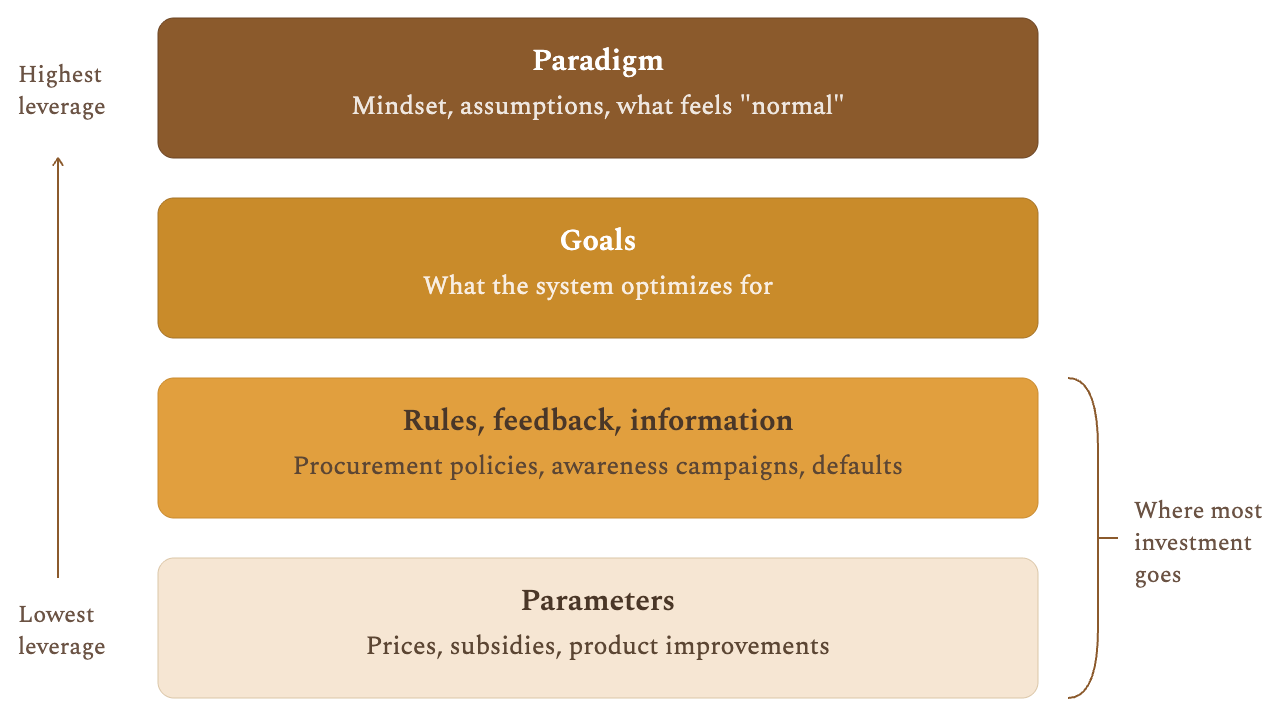
Most U.S. food system work has operated at these lower and middle levels. All valuable, but the paradigm remained untouched. And so the system absorbed the interventions.
How Chicken Beat Beef
What gives me hope that paradigm-level shifts are possible is that they’ve happened before.
In 1960, Americans ate twice as much beef as chicken. Today chicken dominates. Per capita consumption has more than doubled since 1980.
It wasn’t a campaign, and nobody convinced Americans that white meat was healthier. Supply chains industrialized poultry first. By the mid-1960s, 90% of broilers came from vertically integrated operations. This wasn’t a price intervention but a restructuring of the entire supply side. The price collapse followed, and chicken became cheap and everywhere. The preference followed the infrastructure.
The question is whether something similar is possible for plant-rich food, or whether we’re stuck trying to win on persuasion in a system that’s structurally tilted the other way.
The Paradigm We’re In
The current U.S. food system operates inside a set of assumptions so familiar they’re easy to miss: meat is the default, everything else is an alternative to it.
“Alternative protein” accepts this framing. The whole premise is to make plants competitive with meat on meat’s terms: match the price, match the taste, win the consumer. But as long as meat is the benchmark, alternatives remain exactly that. The frame is built into the name.
Neither a new product category nor better messaging will fix this. Blended meat might make it easier for some consumers to reduce their meat intake, but it still operates within the same paradigm: meat as the anchor, everything else as a modification of it. And narrative work, however well-resourced, has mostly tried to make the case for plant-based rather than shift what feels normal in the first place. That requires longer-term work, both at a storytelling and cultural infrastructure level.
Paradigms don't shift when someone proves them wrong. They shift when they start to feel outdated. Consider cigarette smoking: it declined when it became low-status, not primarily because of health warnings but because the cultural meaning changed.
Replicating meat has its place. It meets people where they are and gives them familiar options. But the focus on it has narrowed the movement's imagination. Plant-rich isn't one product category competing with another. It's a systems-level shift in what gets grown, distributed, served, and normalized.
What Could Shift It
I don't know what will shift the food system's paradigm. But I can see forces that might disrupt conventional meat's hold:
Meat as industrial: If 'meat' becomes synonymous with feedlots, disease outbreaks, pollution, and antibiotics, plant-based could inherit the 'real food' positioning. Not by arguing against meat, but by letting industrial meat argue against itself.
Meat as generational: If plant-forward becomes how younger generations distinguish themselves, meat becomes what your parents do.
Meat as unaffordable: Climate impacts, feed costs, water scarcity, supply chain shocks - any of these could push prices up significantly. If meat gets expensive, plant-rich becomes normal by necessity.
Health as driver: The focus on metabolic health is growing, from GLP-1 drugs to the chronic disease conversation. If that becomes how people evaluate food, plant-rich could win on function, not virtue.
None of these are levers we can simply pull. But we can position for them, and be ready when they arrive.
The Question Underneath
Over the past decade, the space has spent enormous resources on what Meadows would call mid-level interventions: better products, smarter campaigns, hard-fought policy wins. All of it valuable, but none of it enough to move the paradigm.
There’s a reason funding flows here: these interventions are tangible, measurable, and show progress on reasonable timelines. Paradigm-level work is slow, indirect, and hard to measure. But the pattern of the last decade is clear: the wins aren't compounding, and the system routes around them.
The asymmetry is striking. We’ve invested heavily in understanding why plant-rich food is good - for climate, for health, for the food system. We’ve invested far less in understanding why meat is so sticky. What needs does it actually meet for people? What identities does it reinforce? What would have to shift for those needs to be met some other way?
We can’t manufacture a paradigm shift. But we can study what would make one possible, invest in the cultural work that shifts what feels normal, and position for the forces that might bring one. None of this replaces mid-level interventions. It’s what could make them transformative instead of absorbed.
I haven't drawn the entire map. But after a decade of watching the system absorb our best efforts, I think this is the direction worth exploring.