
The Question We're Not Asking About Our Food System
Why rethinking purpose should be the precondition to innovation

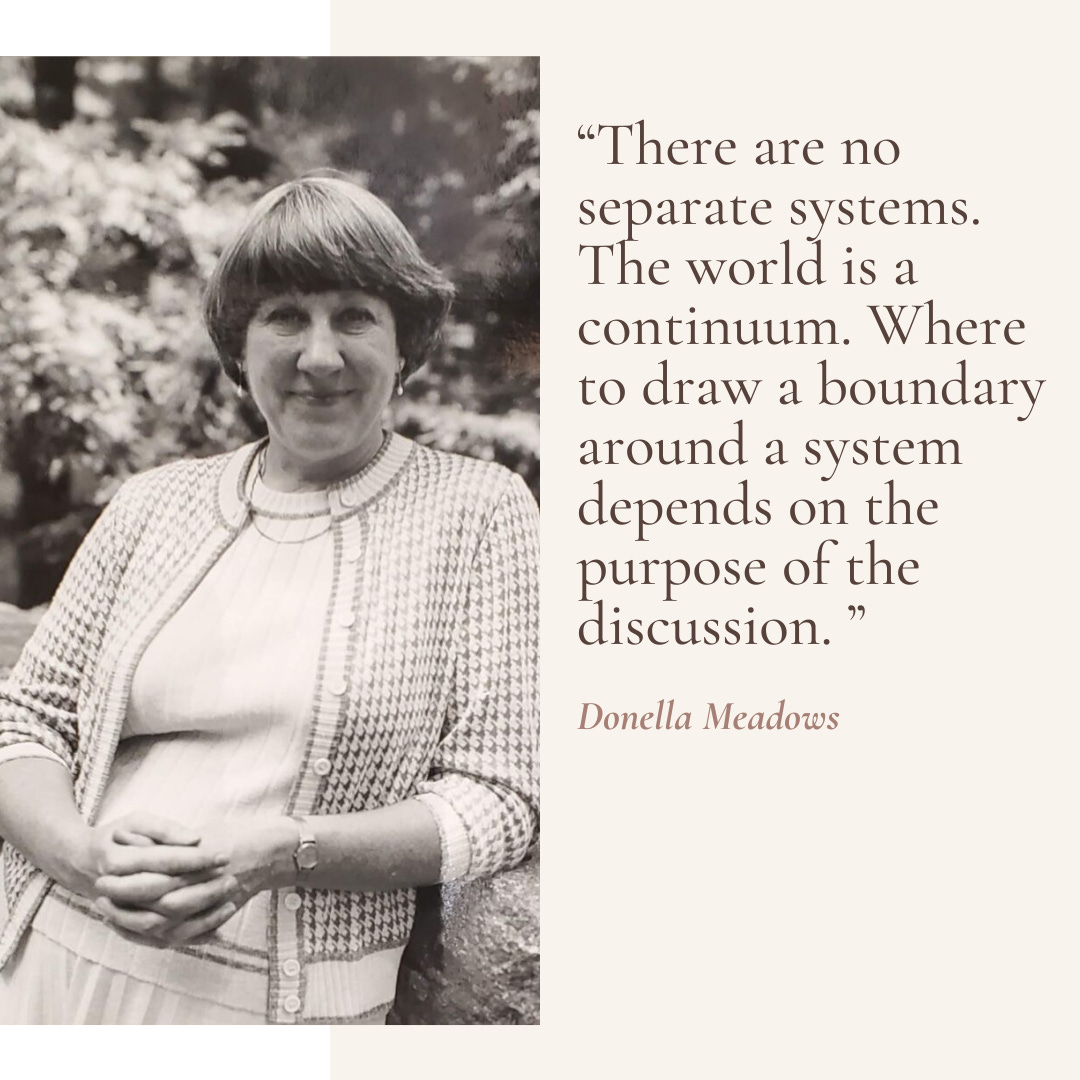
A few years back, while researching food systems, I discovered a 1999 lecture by the late environmental scientist, educator, and writer Donella Meadows that made me think deeply about what real change looks like. At the University of Michigan, she posed a question that still haunts our food debates: "What are we actually trying to do with our food system?"
Not which technologies to deploy or how to optimize efficiency, but what's our fundamental purpose?
This isn't the first time I've explored Meadows' systems thinking approach. Back in 2021, on my Eat For The Planet podcast episode "Confirmation Bias and Negative Externalities," I examined how Meadows' framework helps explain why arguments about food system change "rarely address real differences, produce mutual understanding, or lead to a basis of action.” This insight has become even more relevant today.
In 2025, we're still avoiding this crucial question. We debate plant-based alternatives and regenerative agriculture without confronting the uncomfortable truth: our industrial meat system isn't broken; it's operating exactly as designed. Americans consume nearly 60 pounds of beef annually per person, while cattle remain our largest food-related greenhouse gas source. The system producing, promoting and distributing meat at scale isn't malfunctioning. It's executing its purpose with remarkable efficiency.
This disconnect reveals the profound misalignment between what our food system does and what it should do.
Purpose vs. Reality
Our industrial meat production was architected with crystal-clear purpose: maximize calorie production at minimum cost. By this metric, it's an astounding success, making meat more affordable and accessible than at any point in human history. The issue isn't system failure, it's that the system's original purpose no longer aligns with our evolving values and scientific understanding.
Once established with its infrastructure and cultural expectations, a system creates powerful momentum resistant to change. Our meat production system persists not because it's optimal for today's challenges, but because we've built everything around it, from farm subsidies to culinary traditions to cultural identities.
Jianguo Liu's research on "telecoupling" illuminates how our food system connects distant places through invisible relationships. That New York hamburger links to Brazilian deforestation through complex supply chains. This invisibility makes meaningful reform difficult. When most Americans purchase meat, they see only the end product, not the complex web of environmental, social and economic impacts behind it.
But the biggest transformation obstacle is one Meadows identified decades ago: conflicting goals. We can't move forward until we're honest about what we're actually optimizing for.
Confronting Our Trade-offs

This isn't about designing a perfect food system that accounts for every possible value. Rather, it's about reevaluating how we prioritize our values based on the current reality of our planet and its finite resources. The food system we designed for post-war abundance no longer aligns with the ecological, health, and ethical challenges we face in 2025.
Is our food system meant to produce cheap calories? To nourish population health? To sustain ecosystems by protecting climate, water and land? To ensure equitable access? Or to preserve individual choice?
These goals frequently conflict. A system optimized for the cheapest possible meat undermines ecosystem health. Maximizing producer profits compromises public health. Prioritizing unfettered consumer choice undermines collective climate goals.
This explains why our food debates feel so intractable. Different stakeholders aren't just disagreeing about methods; they're operating with fundamentally different definitions of success. Climate advocates focus on reducing beef consumption while health experts worry about processed meat and chronic disease. Alt-protein companies prioritize mimicking conventional products while regenerative farmers promote better production methods.
Shifting the Paradigm
Meadows argued that the most powerful changes don't come from tweaking parameters (like taxes or subsidies) but from shifting the system's fundamental purpose and paradigm.
This explains why isolated policies like voluntary meat reduction campaigns or minor production efficiency improvements have minimal impact compared to cultural shifts that redefine our relationship with meat. We're adjusting parameters when we need to question paradigms.
Moving forward requires explicit discussions about trade-offs. We cannot simultaneously maximize meat affordability and environmental sustainability, producer profits and consumer health, individual choice and collective well-being, or short-term abundance and long-term resilience.
These are political and ethical choices, not just technical problems awaiting technological solutions.
"We talk as if we could have it all, now, for free," Meadows warned. "We can't. The earth will not produce it. People will not endure it. Our own health and sanity will not permit it."
Twenty-six years later, her words feel prophetic. Our industrial meat system delivers exactly what it was designed for: abundant, cheap animal products regardless of externalized costs. If we want something different - something aligned with today's values and scientific knowledge - we don't just need better products or policies. We need a fundamentally different system with a different purpose.
Innovation without clear purpose is like building a faster car heading in the wrong direction. We've become obsessed with how to make food production more efficient, more technological, more profitable - without first establishing what we're truly trying to accomplish. True transformation demands that we establish purpose as the precondition to innovation, not the other way around.
That starts by answering Meadows' question: What are we actually trying to do with our food system? Until we align on that, we'll keep developing impressive innovations that solve the wrong problems while the root causes persist.