
The Protein Ladder: How Supply Shapes What We Eat
Shifts in what proteins we produce and prioritize; from beef to chicken to plants; don't just cut emissions. They reshape markets, norms, and the way food culture evolves.

Here’s something we get wrong about changing food culture: we think it happens because people suddenly decide to eat differently. That someone reads the right article, watches the right documentary, or has the right conversation, and then, click, their habits transform.
But that’s not how it works (at least for the vast majority of people).
Agriculture drives about a third of global greenhouse gas emissions, with animal-based foods responsible for roughly 60 percent of that impact while delivering less than 20 percent of the world’s calories. Beef dominates land use, water consumption, and methane emissions. If we’re serious about feeding nearly 10 billion people by 2050 without breaking the planet, we need to rethink protein; not by cutting people off, but by shifting supply toward more sustainable options.
Less beef, more chicken. More fish, more legumes, more plant-based products. It’s about bending the system, not snapping it.
And here’s what most people miss: food culture doesn’t shift because people change their minds. It shifts when supply changes first.
A Note on Priorities
If we’re serious about making the food system more resource-efficient and sustainable, we have to move past absolutist framing of solutions; whether regenerative, plant-based, animal-free, or anything else. I understand that others may prioritize different values: animal welfare, cultural preservation, taste, tradition, equity, affordability. Those matter, and they’re worth fighting for. But I believe we need to optimize the food system first for long-term survival to ensure it continues playing the critical role it does in nourishing populations globally, however imperfectly it does that today. The first priority has to be keeping the system viable. Once we secure that foundation, we can build on it and optimize for other values; a food system that can’t sustain itself can’t deliver on equity or animal welfare either.
That’s just my take. Many plant-based advocates will bristle at the protein ladder I’m suggesting here, given that plants are clearly the most resource-efficient option. They’re right about the efficiency. But we aren’t going to leapfrog to a plant-forward food system overnight, and insisting we must only delays the progress we could be making right now.
The updated EAT–Lancet Commission backs this up, calling for roughly a one-third reduction in ruminant meat by 2050 and naming poultry and plant proteins as the most practical substitutes.
Supply Creates Demand (Not the Other Way Around)
Think about chicken.
Fifty years ago, Americans ate far more beef than chicken. Today, chicken is the dominant protein in the U.S. In 2021, Americans consumed 68.1 pounds of chicken per person compared to 56.2 pounds of beef. That didn’t happen because people suddenly decided white meat was healthier or tastier. It happened because supply chains industrialized poultry, drove down prices, and made chicken ubiquitous: nuggets, tenders, wings, strips, sandwiches. By the mid-1960s, 90% of broilers came from vertically integrated operations, allowing the industry to leverage new technologies to become dramatically more efficient. Since 1980, U.S. chicken availability per person has more than doubled from 32.7 pounds. Once chicken was everywhere, it became the default.
Defaults, placement, and price shape what people eat far more than arguments about health or sustainability ever could. This is especially powerful when products stay within familiar territory. Beef to chicken? Both are meat. A burger that delivers the same experience with a lighter footprint? Still a burger. The friction comes when you challenge category boundaries; when a product is positioned as an “alternative” rather than simply another option within the category. Change what’s available, affordable, and convenient, but do it in ways that preserve the mental models people already have.
The Climate Gradient of Protein
Not all protein carries the same environmental weight.
Beef: Producing one kilogram of beef protein emits up to 50 kilograms of CO₂ equivalent and requires more than 20 times the land of legumes.
Pork: Roughly half the emissions of beef, still resource-intensive.
Chicken: Eight to ten times lower emissions than beef, with far less land and water use.
Fish: Variable depending on species and production method, but often lighter than beef.
Plants: Lentils, beans, and soy sit at the bottom of the curve, requiring a fraction of the land and water.
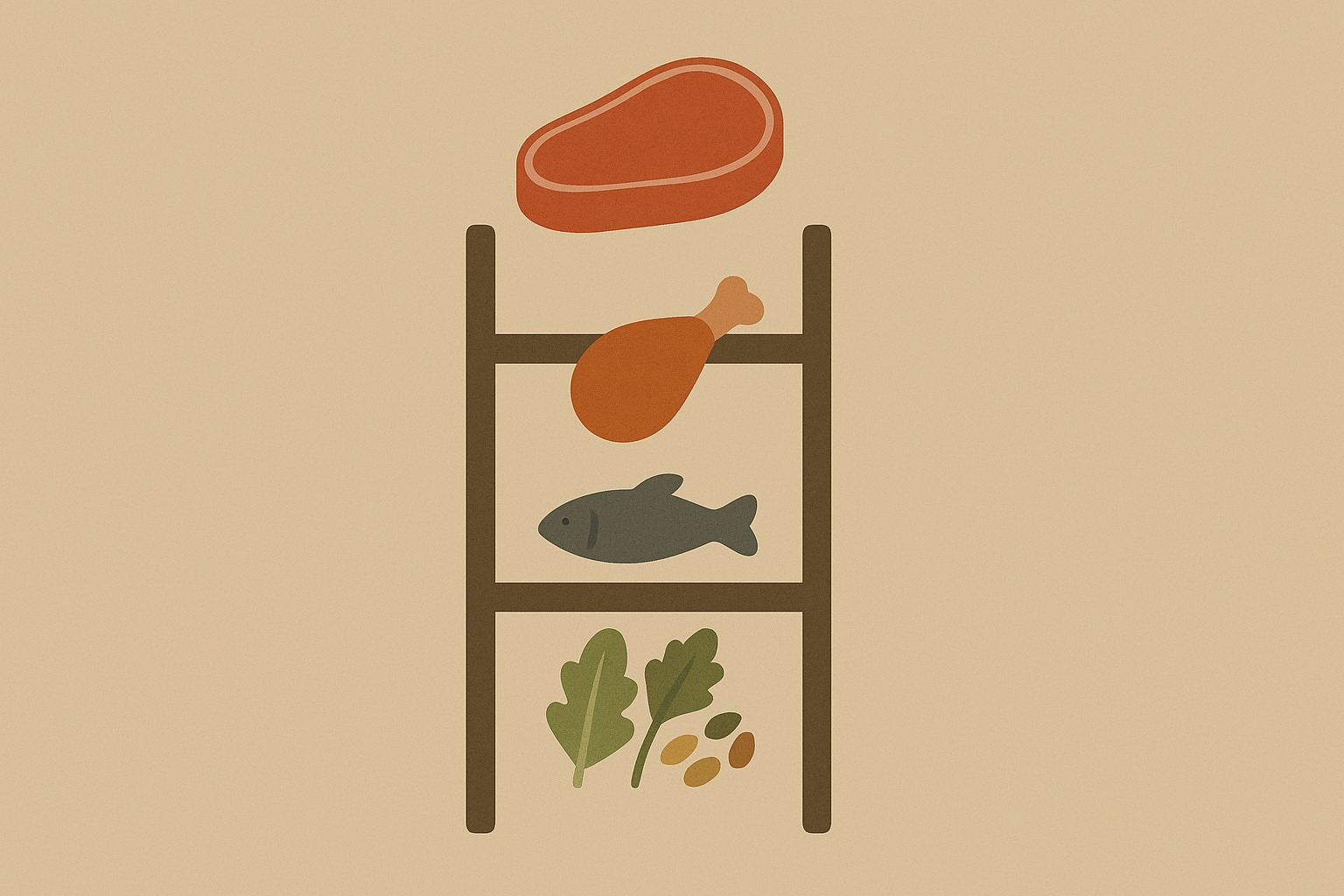
Even modest shifts down this ladder create measurable climate gains. We’re not talking about perfection; we’re talking about direction.
From Supply to Perception
Supply shifts don’t just cut emissions; they change how we see food itself.
A cafeteria that defaults to chicken instead of beef reframes what a “normal lunch” looks like. A workplace that sets plant-forward meals as the baseline reshapes what convenience means. A fine-dining restaurant that treats vegetables or fish as the centerpiece redefines aspiration.
Over time, what once felt fringe becomes familiar. What once seemed like sacrifice becomes normal. And what’s normal becomes invisible.
Real-World Signals
We already have evidence of how this works:
Institutional defaults: Research at Harvard and UCLA showed that setting plant-based meals as the default increased uptake by 43 to 56 percentage points in randomized trials. A subsequent six-university study found similar results, with plant-based defaults resulting in estimated reductions of 104,387 kg of CO2 emissions, representing roughly 45% reductions in environmental impacts. People adapted because the choice was easy.
Corporate commitments: Major food service operators are reshaping menus to prioritize lower-impact proteins. Sodexo’s Campus division pledged to make 50 percent of its menus plant-based by 2025, while also shifting away from beef. Other institutional kitchens are defaulting to chicken over beef, reducing portion sizes, and making higher-impact meats opt-in rather than standard. That scale changes habits for millions of daily eaters through availability, not persuasion.
Retail positioning: The explosion of chicken formats across retail, from rotisserie to pre-seasoned to ready-to-eat, made chicken omnipresent and effortless. When a protein appears in every section of the store and every slot on the menu, it stops being a choice and becomes a default. Ubiquity creates familiarity, and familiarity drives consumption.
Each of these examples begins upstream, in supply decisions. But their effects cascade downstream, into culture, habit, and eventually identity.
Leaving Room for Meat (Because It’s Not Going Anywhere)
Here’s the uncomfortable truth: meat isn’t disappearing anytime soon. Pretending we can swap it out overnight makes the sustainability case less credible, not more.
The better path? Leave room for meat, but shrink its share and shift its form. Less beef, more chicken. Less chicken, more plants. Smaller portions, better defaults. A ladder of options that lets people move down the emissions curve without requiring an identity overhaul.
The Path Forward
If we want a sustainable food culture (one that actually feeds billions without wrecking ecosystems) we need to:
Reform supply chains to prioritize lower-impact proteins at scale. That means infrastructure and policy support for chicken, fish, legumes, and plant-based alternatives. It also means improving how we produce the proteins we already eat; more efficient animal agriculture, regenerative practices where they deliver real impact, and systems that minimize waste and resource use.
Normalize defaults that make sustainable choices effortless. Set plant-forward meals and low-impact animal-based meats like chicken and seafood as the standard in institutions, workplaces, and food service, with higher-impact options available by request. When choosing the lower-emission meal requires zero extra effort, adoption scales.
Accept meat’s role while shrinking its share. Reduce portion sizes, make beef and pork opt-in rather than default, position chicken and fish as the go-to animal proteins, and ensure plant-based options are always present and appealing. The goal isn’t elimination; it’s right-sizing.
Invest in innovation that makes alternative proteins better, cheaper, and more widely available.. Plant-based meat remained 77% more expensive than conventional meat in 2023, and price is a major barrier identified by nearly a third of consumers who stop buying these products. This applies to plant-based, mycelium, cell-based, and blended products alike. Without price parity and sensory equivalence, scale remains out of reach.
Culture follows supply. By shifting the protein mix on offer, we can reshape habits, perceptions, and eventually identities. That’s how we build a food system that reduces emissions, protects ecosystems, and still feeds billions.
The future of food won’t just be decided on the plate. It will be decided in the supply chains that determine what proteins end up there in the first place.