
Cultivated Meat Is a Harder Sell Than Plant-Based Ever Was
The barrier is trust, not science. And it can be solved.

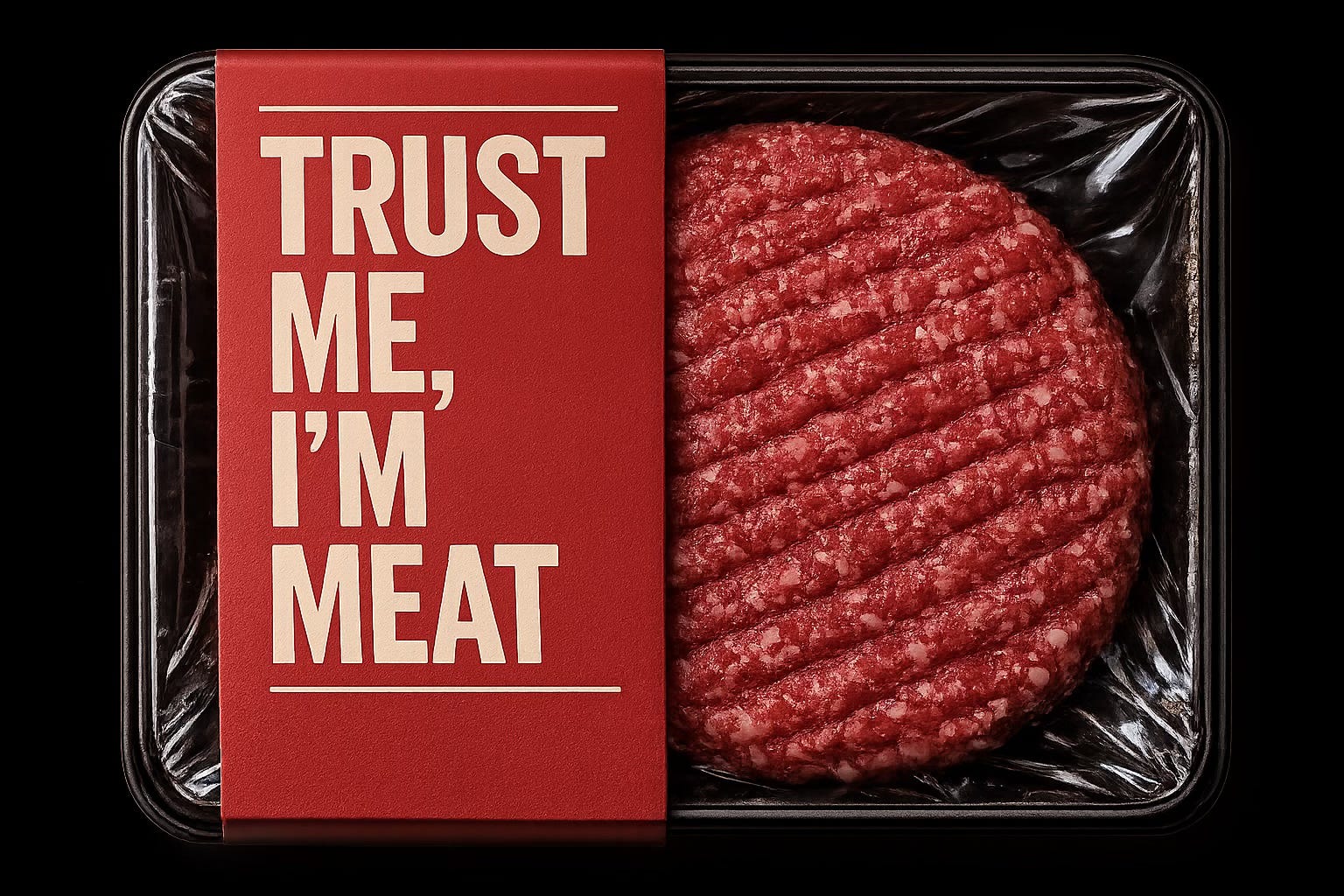
I have followed cultivated meat since the first burger was eaten on live television in 2013, without writing much about it, mostly because there was little to write that wasn't a research milestone or a funding round. I have also talked to many of the people building it. Bruce Friedrich founded the Good Food Institute and has done as much as anyone to make the case for alternative proteins. He has been on the Eat For The Planet podcast three times, and you can hear the story shift across them. The first two (#3 and #61) were framed around “clean meat,” the term much of the advocacy world used in the early days, and the pitch leaned on the idea that the science behind regenerative medicine could be pointed at dinner. By the third the vocabulary had moved on, with clean meat giving way to alternative proteins and cultivated meat inside a wider and more critical argument about the food system. Over the years, the headlines rarely changed in character: a new cell line, a cheaper growth medium, a bigger bioreactor, another approval somewhere, another round raised mostly to keep the lights on, and lately a run of shutdowns, including Believer Meats closing its doors weeks after winning regulatory approval and finishing what was billed as the world’s largest cultivated meat plant. Some of it was progress and some of it was collapse, and none of it touched the only question I care about, which is whether people will eat this and how it gets into their lives.
What finally pushed me to write was Sami Nabulsi (who runs Pythag Tech). Sami came on the podcast last year and recently published the most rational bull case for cultivated meat I have read. His argument is that the existential questions that hung over the industry from 2016 to 2022 have largely been answered, that the money left anyway, and that the gap between improving fundamentals and retreating capital is where the opportunity sits. I agree with almost all of it. I just think he is confident about the part I am least sure of: whether people will accept this at all.
Scale and cost aren’t there yet, but those are problems the space knows how to work on, and it is already being banned outright before it has a real chance to compete on either. The barrier no one has a plan for is trust.
Before going further, a word on what I mean. By cultivated meat I am talking about the everyday kind, the beef, pork, and chicken most people eat. Cultivated seafood is a related but separate story, with a different consumer and far weaker political opposition, and it is not the one I am telling here.
Why it’s the harder sell
Plant-based meat’s central problem was always taste. It had to persuade you that something made from plants could replicate meat, and for a long stretch it couldn’t, which is why so many people tried it once and never came back. Then, just as the products were getting closer, the ultra-processed backlash hit. Part of that was fair, since engineering plants to look and taste like meat is a processed exercise by definition, and a company that engineers food to win a taste test and thinks about the label afterward cannot credibly call it unprocessed. But it would be wrong to lay it all on the companies, because the backlash was not purely organic. The meat industry and the groups it funds spent real money, including Super Bowl ads and full-page newspaper spreads, casting plant-based meat as ultra-processed and fake, and the brands were fighting that on a tilted field. And underneath all of it was the thing I keep writing about: trust and culture. The plant-based industry also assumed that if it nailed taste and price people would follow, so it put almost everything into the product and far less into the cultural work that decides whether a new food takes hold.
Cultivated meat looks like it should skip the first problem entirely, since it is animal cells, the same tissue you already eat, grown a different way. That should put it through the door plant-based could never quite open. It doesn’t, because the reflex that made plant-based hard to swallow, the sense that it is fake or strange, runs deeper here, not shallower. Tell someone their chicken was grown in a bioreactor and you get a worse reaction than telling them it was made from peas. The surveys back this up. In a 2023 survey, about half of people said they were not very or not at all interested in eating cultivated meat, and the reasons they gave were weirdness and worries about safety rather than taste. The framing does damage too. The companies settled on the term “cultivated,” but the public mostly hears “lab-grown,” and research across US and German consumers finds the two describe the identical product while landing very differently, with “lab-grown” lowering both appeal and willingness to pay.
This maps directly onto the Five Conditions I wrote about recently. Two of them, familiarity and narrative, are where cultivated meat struggles most, more than anything else in alternative protein. It is unfamiliar in a way that reads as unsettling rather than novel, and the story most people have heard was shaped by the people fighting it.
The industry has spent years trying to explain its way past this, and the results are not encouraging. When researchers test the science-forward pitch, the bioreactor, the process, the technology, it produces lower acceptance than simply framing the product as similar to ordinary meat. And trying to argue people out of the unnaturalness reflex has a thin track record. Those perceptions turn out to be strikingly resistant to correction. The unease was never a factual misunderstanding of how the meat is made, which is why explaining the process better does not fix it.
You can see why it is stuck by looking at how it is being stopped. Seven states have banned it outright, Florida among the first, and Florida’s ban was upheld in federal court earlier this year. None of that was about safety. The language was “save our beef” and meat grown in a petri dish. A product can win every argument in the lab and still hit a wall built out of distrust and politics, and no amount of R&D efficiency climbs over it.
Be the supplier, not the brand
Once taste and price are settled, and for cultivated meat taste is largely handled in principle, the only path that works is for the meat industry itself to sell it.
What does not work is a technology startup out of San Francisco trying to convince people that its bioreactor chicken is better than the chicken they currently buy. For a product this sensitive to trust, that is close to the worst possible messenger. I have made this point before, that the last mile of food adoption happens not in a factory or a product review but in a neighborhood, on a shelf people already know, through a brand they already trust. A food-tech startup has none of that, and asking it to build trust from nothing, for a product people are already wary of, is asking it to do the one thing it is least equipped to do.
This is why copying the Beyond and Impossible approach would be a mistake. That model built standalone brands, sold the product as the cleaner and more virtuous choice, and asked people to switch on conviction. It was a hard road for plant-based and would be harder for cultivated, where you are also fighting the sense that the food is unnatural. The better move runs the other way, toward disappearing instead of standing out. Cultivated meat should not ask anyone to admire how it was made. It should turn up inside brands people already trust, on the same shelf and in the same products, blended into conventional meat at first, with the familiar label in front and the bioreactor out of the story. The startup supplies the cells and lets the incumbent’s existing story do the talking, the way no one narrates where the ingredients in a familiar product came from. Plenty of people argue the incumbents should take part in cultivated meat. Almost no one says the startup should supply them and let the product vanish into a label nobody questions.
The retail meat case is more brutal than it looks. Shelf space is expensive and effectively rationed, often through slotting fees and category deals that favor the companies already there, and the margins on fresh meat are thin enough that you only make money at the scale and vertical integration the big processors have and a startup never will. A few grass-fed and regenerative brands like Teton Waters Ranch and Verde Farms have earned real shelf space, and they are, by most measures, the better product, cleaner, no antibiotics, raised outside the factory-farm system, the exact story cultivated meat wishes it had, and it still leaves them a small, higher-priced niche rather than a threat to the processors who own the conventional case. When one of these brands does prove itself, the incumbents tend to buy it, the way Hormel bought Applegate. The only genuinely new names to break through onto mainstream shelves were Beyond and Impossible, both plant-based, and between them they raised and spent billions and are still not profitable. If the two best-funded food startups in a generation could win that shelf and still lose money, a cultivated startup asking people to trust bioreactor meat from a company nobody has heard of is starting much further back.
The cultivated companies are launching the way you would expect, through chefs and restaurants. Upside debuted its chicken at the Michelin-starred Bar Crenn, the kind of high-end room where most of these companies have staged their first tastings. But a restaurant debut is mostly a function of limited supply and a high price, and it says little about who ultimately sells the product. The real question is what comes after the tasting menu, and Upside, the company furthest along, has answered it: its stated plan is to build its own brand, restaurants first and retail later. Selling through a restaurant is still selling as Upside, which is different from the supplier role I am describing, where the cells go to a Tyson or a Perdue and disappear into a trusted label. The generous read is that the brand is just a tool while the science scales, with licensing or supply the real plan later, and Upside has in fact floated licensing, so the supplier model is not foreign to it. Maybe. But brand-building is where the years and the money go, not a cheap option you set down on schedule, and you do not need a consumer brand to run a tasting. Showing people the product and owning the label are different choices, and building a standalone brand to fight for shelf space it cannot win is the mistake the space keeps making.
Big Meat is already hedging
Some of this is already underway, just not the way it gets reported. Tyson, Cargill, and JBS have all put real money into cultivated companies. Tyson backed Upside, Cargill backed Upside and Aleph Farms, and JBS committed around a hundred million dollars, bought Spain’s BioTech Foods, and built both a research center and what it calls the largest cultivated beef plant in the world. The big meat companies are hedging their bets so they keep their market no matter which protein wins. The hedge is cheap, too, since cultivated meat is still far more expensive than the beef and chicken they sell today and a rounding error next to their volume, so a small stake costs them little and there is no near-term threat worth fighting.
But the meat industry is not one thing. The processors write the checks while the ranchers write the bans. A startup's job is to sell to the processors, not to compete with them on the shelf.
Something else is pushing cultivated meat forward, and it has little to do with the supermarket. The fastest-growing case for cultivated meat is now resilience, the idea that a country whose protein supply can be knocked out by a disease outbreak or a trade shock is safer with more than one way to make meat. The screwworm now turning up in Texas cattle, avian flu in poultry, and a push to treat food biomanufacturing as national infrastructure are drawing government money and national-security attention, with Germany and Japan building policy around it. None of that runs on consumer enthusiasm. It runs through institutions, manufacturers, and government-backed capacity.
The hard part isn’t the supply side
None of this is a plan for next quarter. The processors are not about to buy cultivated beef and blend it into their ground beef, because there is nothing yet to buy at the scale or the price that would make it worth their while. Cost has to fall a long way and volume has to climb a long way first, and that is real work that will take years. But that is why the choice of what to build toward matters now, in the middle of the R&D phase, and not once the science is ready. A company aiming to supply a Tyson makes different decisions today, about what it patents, who it raises from, and which partners it courts, than one spending a decade becoming a name shoppers are supposed to recognize. The most visible plans still point at the shelf, and the handoff they are waiting for arrives on the same economics the incumbents’ early stakes are hedging: parity at volume. When it comes, the advantage will sit with whoever spent the wait becoming the better supplier.
I do not have much to add to Sami’s read of the supply side, because he gets the whole supplier logic right. The companies that flamed out failed on execution and a consumer-brand model that was wrong from the start, not on the underlying idea. He is right about the fix too: hold one position in the value chain, concentrate on R&D, and hand trust and distribution to the food companies that already have them. That last part is the heart of it.
I would push on two things. He treats the consumer as more or less solved, and I have spent this whole piece arguing the opposite. Bruce Friedrich has framed the goal for years as products that taste as good or better and cost the same or less, and he is right that those are the price of admission, but admission is all it buys. Getting the science right gives you a product that works, not a product people want. And Sami treats the politics as a passing mood, when the bans are spreading and a federal court just upheld the first of them. For a food carrying this much baggage, that is not weather you wait out. It is part of the surface the product has to land on, and it has to be designed around.
There is one more piece of the serious bull case worth naming, and the fullest version of it is in Bruce Friedrich’s new book, Meat. His argument is that this transition will not run on venture capital alone and needs sustained public funding, the way Singapore, Israel, and others have backed the science as industrial policy. I think he is right, and the money would do real work, because cost and scale are genuine barriers and public funding is one of the few things that could actually move them. But it moves the half of the problem the industry already knows how to work on, buying a cheaper product and a faster cost curve rather than the trust, and it runs into the same wall the bans just showed, because the politics outlawing the product in seven states are not a stable base for the decades of bipartisan funding the plan assumes. The money helps build the thing, but it does not make people want it, and here it is exposed to the very forces working hardest against it.
Cultivated meat wins by disappearing
The optimistic case is right about the long run. The underlying promise is real, with animal protein produced without slaughter, on less land and with fewer resources, plus real flexibility in how a country feeds itself. None of that depended on the hype, and none of it left when the hype did.
But I want to push this harder than the supplier framing usually gets pushed, because that framing stops one step short. Follow the logic all the way down and it stops being a go-to-market tactic at all: the most successful version of cultivated meat is one where no one is ever sold cultivated meat. This is not an argument that story stops mattering. Story is the whole problem. It already belongs to the people who want cultivated meat gone, and no startup is going to out-tell them on any believable timeline.
Think about how much of what you already eat works exactly this way. The rennet in your cheese, the citric acid in almost everything, the B12 in your cereal, the enzymes in your bread, are all grown in tanks by companies you have never heard of and will never think about. Nobody markets them, nobody chooses them, and that invisibility is the entire point. The winning version of this technology looks like that, a cell line and a process licensed into the meat people already buy, under trusted labels, with no one at the table any the wiser. I have stopped believing the real question is whether people will eat cultivated meat. The question that decides this is whether it can become an ingredient nobody ever thinks to ask about.
This is not the oldest trick in the meat business, the one where you keep people from looking too closely at their food. The label can say exactly what the product is, and what disappears is the sales pitch built around how it was made, not the honest disclosure of it. Conventional meat hides its production because the truth would cost them. Cultivated meat hides nothing, it only declines to dramatize a process that unsettles people for no good reason.
The politics point the same way. The processors could carry the product, but they lean on the very ranchers writing the bans, so they cannot back it out loud. Quiet entry is not just the smart play, it is the only door left open.
I will be honest about the cost, because it is bigger than a price premium. The halo, slaughter-free, less land, less suffering, is the moral case, and the moral case is real. But sell on it and you reach only those already convinced, the few who switch on conviction, and the modern plant-based wave spent a decade and billions proving that group is too small to change anything. Burying the halo is not a betrayal of the moral case, it is how the product reaches everyone it will never move, and the truth stays on the label for anyone who looks.
So I am bullish, with one condition, and it is not the one everyone keeps reaching for. Cultivated meat does not need a louder or cleverer pitch. It needs to stop being a product people are asked to believe in and start being an ingredient they never notice. The companies that understand that, and build to fold into the trusted channel instead of replacing it, are the ones I would watch. Everyone else is still racing to perfect the science, as if that were the finish line instead of the price of entry.
This is the sharpest thing I've read on cultivated meat, and the naming study is what makes the argument stick. Reading your three findings together, they all move the same way: the more process information a description carries, the lower the acceptance, whether it comes from the pitch, the label, or a correction. Which puts pressure on the one place you hold the line.
If lab-grown and cultivated shift willingness to pay for an identical product, then honest disclosure is itself a small dose of the variable. How do you think about where that line sits?
Exactly. If cultivated meat eventually becomes the lower-cost, more efficient way to produce meat, I could see the biggest meat companies becoming its strongest advocates because it would simply make good business sense. They already have enormous influence with policymakers and are probably in a much better position than startups to help normalize and scale it. If that quietly replaces slaughter with cultivation, that's an enormous win for animals.